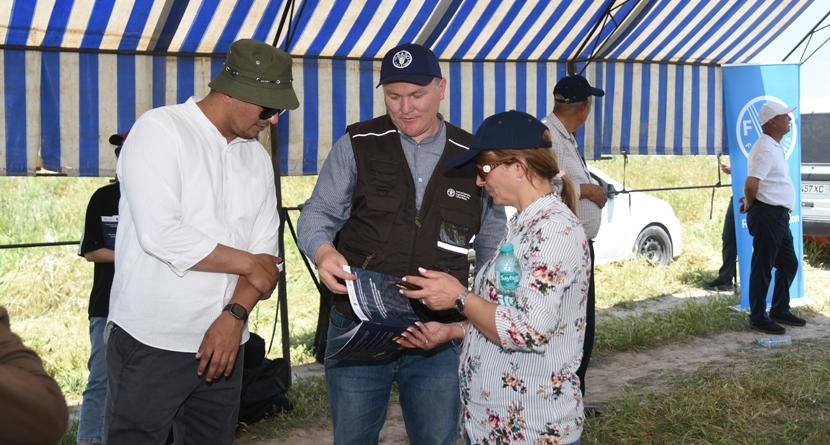
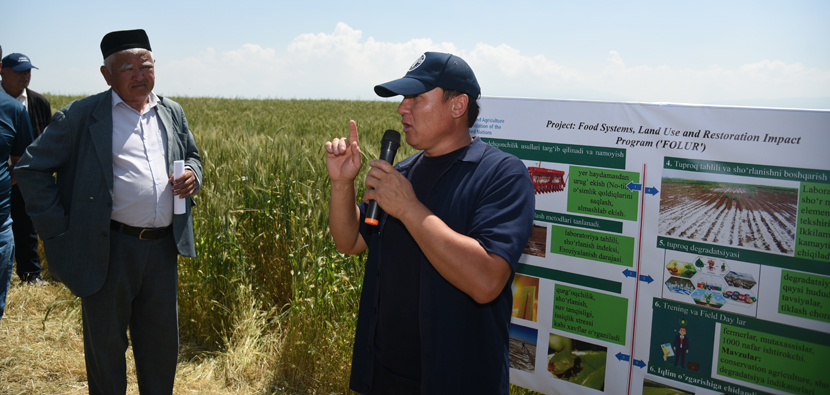
Qamashi, Qashqadaryo region, 13 May 2026 — A Field Day on “No-Till crop production and rainwater harvesting technologies in rainfed areas” was held in Qamashi district, Qashqadaryo region. The event was organized within the framework of the Food Systems, Land Use and Restoration Impact Program in Uzbekistan (FOLUR-Uzbekistan).
The GEF-funded project is implemented by the National Committee on Ecology and Climate Change of the Republic of Uzbekistan, the Ministry of Agriculture of the Republic of Uzbekistan and the Food and Agriculture Organization of the United Nations (FAO). The objective of the project is to scale up best practices and innovations for sustainable and inclusive wheat-based production landscapes and value chains.
The event was attended by Deputy Minister of Agriculture of the Republic of Uzbekistan Jamshid Abduzukhurov, Assistant FAO Representative in Uzbekistan Sherzod Umarov, representatives of the Ministry of Agriculture and regional agricultural departments, farmers, specialists and project partners.
During the seminar, participants were provided with information on the key principles and advantages of resource-efficient and soil-protective technologies under the FOLUR project, as well as on maintaining soil fertility, managing soil moisture and making effective use of crop residues. Participants also visited the demonstration site, where they observed practical field activities related to No-Till technology, as well as demonstrations of soil profile and infiltration.
The event showcased the effectiveness of No-Till winter wheat production, crop rotation, maintaining crop residue cover on the soil surface, soil moisture retention, water infiltration and soil compaction indicators. Participants also compared crops grown using conventional technologies with those grown without tillage.
One of the key areas of the Field Day was the demonstration of rainwater harvesting technologies and their effective use. Within the framework of the FOLUR-Uzbekistan project, rainwater harvesting technologies have been introduced on three sites covering a total area of 6 hectares in Qashqadaryo region. These include stone-reinforced gradoni terraces for steep slopes, non-reinforced gradoni terraces for medium slopes, and trenches, pits and water-guiding strips for low slopes.
Participants also learned about rainwater harvesting technologies during the vegetation period of pistachio. Information was presented on the pistachio areas where rainwater harvesting technologies have been applied under the project. In addition, participants observed semi-circular water harvesting structures. This technology helps retain rainwater in the soil and direct it to the plant root zone, enabling more efficient use of moisture in rainfed areas. This is particularly important for adapting agricultural production to climate change in arid regions.
During the Field Day, farmers shared their experience and practical results. Discussions focused on recommendations for improving soil fertility, increasing yields, using water resources efficiently and expanding sustainable agricultural practices in rainfed areas.
Such Field Days under the FOLUR-Uzbekistan project provide farmers and specialists with an opportunity to observe new technologies directly in field conditions, assess their practical effectiveness and adapt them to local conditions. The event also contributes to strengthening practical cooperation among farmers, sector specialists, government institutions and international partners.
FAO and partner organizations will continue supporting the wider introduction of soil-protective, resource-efficient, water-saving and climate-adapted agricultural practices in Uzbekistan to develop sustainable food systems, restore land resources and strengthen the resilience of farming systems.