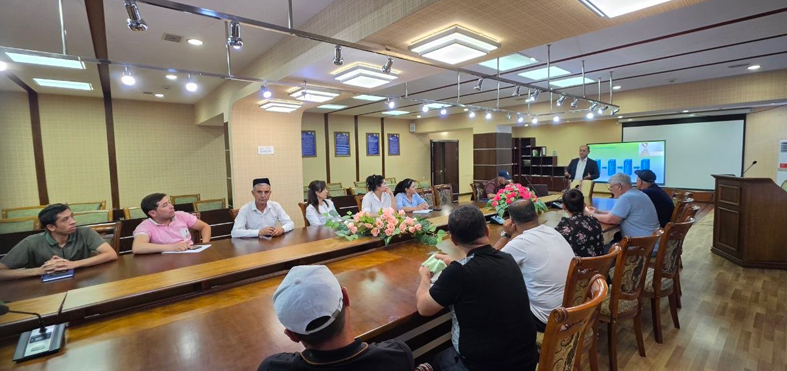
KASHKADARYA REGION, UZBEKISTAN — Activities aimed at advancing conservation agriculture, strengthening local technical capacity and promoting the practical adoption of resource-efficient technologies were held in Kashkadarya Region under the Food Systems, Land Use and Restoration Impact Program in Uzbekistan (FOLUR-Uzbekistan).
A Training of Trainers programme was conducted at the Southern Agriculture Research Institute in Karshi, bringing together 20 researchers and agricultural specialists. The training was organized under FOLUR Project Outcome 2.1, which focuses on promoting sustainable and resource-efficient agricultural production and strengthening the capacities of farmers, specialists and local institutions.
Participants gained practical knowledge of key conservation agriculture principles, including No-Till planting, retaining crop residues on the soil surface, crop rotation, soil-moisture conservation and the efficient use of available water resources.
Presentations and professional discussions addressed approaches to working with farmers, translating technical knowledge into practical recommendations, and incorporating field observations and research findings into training activities.
The trained specialists will share their knowledge and experience with farmers and support the establishment of Farmer Field Schools. This approach is intended to expand the adoption of sustainable agricultural practices progressively — from trainers to farmers and from farmers into practice.
A separate project activity was held at the Jo‘vli bobo o‘g‘li Baxtiyor farm in Savsan village, Qamashi district. Farmers, agronomists, machinery operators, researchers and project specialists observed the direct planting of wheat using No-Till technology.
During the field demonstration, the Nushkent wheat variety was planted on a 40-hectare field using a specialized No-Till seed drill. Wheat had also been cultivated on the same field during the previous season. For the new cropping season, the field was left unploughed, while straw and other residues from the previous crop were retained on the soil surface. Wheat seed was planted directly through this protective residue layer.
Project specialists demonstrated the preparation, calibration and operation of the No-Till seed drill. Particular attention was given to planting depth, row placement and uniform seed distribution. Participants also discussed practical considerations for applying the technology under local soil and climatic conditions.
No-Till minimizes mechanical soil disturbance. Retaining crop residues on the soil surface can help conserve soil moisture, reduce wind and water erosion, and create favourable conditions for soil biological activity. Reducing tillage operations can also lower fuel consumption, labour requirements and the time needed for field preparation.
The 40-hectare demonstration field will be monitored throughout the growing season. Monitoring will cover crop emergence and development, soil-moisture retention, the effects of crop residues, resource use and final grain yield. The findings will provide field-based evidence for assessing the performance of No-Till under local conditions and its potential application in other suitable areas.
About FOLUR-Uzbekistan
The Food Systems, Land Use and Restoration Impact Program in Uzbekistan promotes sustainable agricultural production, integrated land management, the restoration of degraded landscapes and resource-efficient farming practices.
The project is implemented in partnership with the National Committee on Ecology and Climate Change of the Republic of Uzbekistan, the Ministry of Agriculture of the Republic of Uzbekistan and the Food and Agriculture Organization of the United Nations (FAO), with financial support from the Global Environment Facility (GEF).