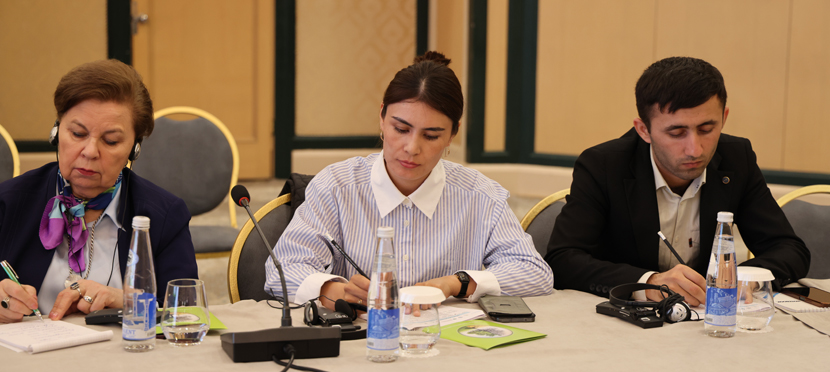
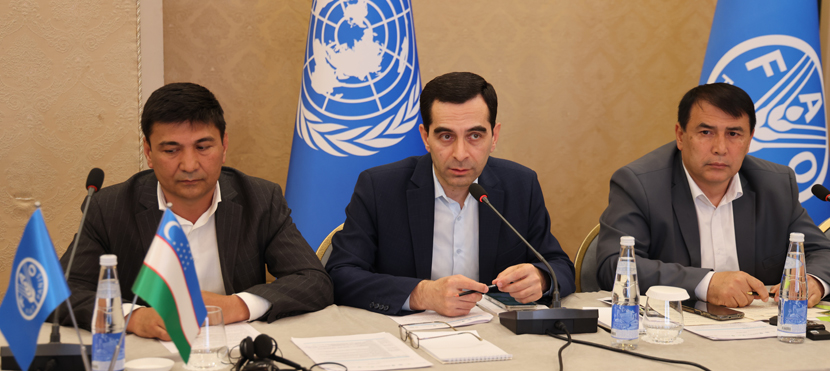
Tashkent, April 2026 — A roundtable was held in Uzbekistan to discuss a Decision Support System (DSS) to strengthen sustainable land use and to support national efforts to achieve Land Degradation Neutrality (LDN).
The event was organized within the framework of the project “Sustainable Forest and Rangelands Management in the Dryland Ecosystems of Uzbekistan”(2022–2026), funded by the Global Environment Facility (GEF) and implemented by FAO in partnership with the Ministry of Agriculture of the Republic of Uzbekistan.
The event was organized within the framework of the project “Sustainable Forest and Rangelands Management in the Dryland Ecosystems of Uzbekistan”(2022–2026), funded by the Global Environment Facility (GEF) and implemented by FAO in partnership with the Ministry of Agriculture of the Republic of Uzbekistan.
The project’s primary objective is to support national actions to reduce land degradation, desertification and drought impacts, to restore land resources, and to promote sustainable management of forests and rangelands.
Land degradation, desertification and drought in Uzbekistan have direct impacts on agriculture, natural‑resource use and ecosystem stability. According to the data presented, of the country’s 25.6 million hectares of rangelands, 2.5 million hectares are degraded and vegetation cover has been lost on a further 6 million hectares. Of the 1.9 million hectares of irrigated cropland, 45 percent are affected by salinization. Average rangeland productivity has fallen from 3.2 to 2.4 centners per hectare.
Against this background, the LDN approach is regarded as an important practical tool for evidence‑based decision‑making on land protection, restoration and sustainable use. Under the project, assessments of LDN indicators — including land cover, land productivity and soil organic carbon — are being carried out; simplified field methodologies for surveys are being developed; and recommendations and guidance for combating degradation are being prepared.
During the seminar, the “Land Degradation” Geoportal and the linked Field Maps mobile application were presented. These tools enable systematic collection, entry and analysis of data on soil quality, salinity, agrochemical testing and rangeland geobotany. The geoportal compiles a database organized in 17 thematic layers, covering agricultural land, forests, water resources and other land categories relevant to land‑degradation response.
The geoportal is designed to improve the quality of decision‑making by integrating data from multiple agencies. The system is planned to incorporate data from the Ministry of Water Resources, the Ministry of Mining Industry and Geology, the National Committee on Ecology and Climate Change, the Forest Agency, the Hydrometeorological Service, the Institute of Soil Science and Agrochemistry, and the “Uzdaverloyiha” Institute.
Practical activities under the project are already under way. The Bukhara branch of the Institute of Soil Science and Agrochemistry has been equipped with two modern laboratory instruments worth USD 110 000. Initial assessments and mapping were carried out on 28 100 hectares in Jondor district and 3 700 hectares in Nurota district. Preliminary LDN indicator assessments — including land cover, land productivity and soil organic carbon — have been conducted in Bukhara and Navoi regions.
Session topics included the application of the LDN concept in Uzbekistan, coordination of data collection and analysis, identification of degradation hotspots and vulnerable areas, and the current status of national reporting. Presentations covered geobotanical surveys in Bukhara and Navoi regions, assessment of current rangeland conditions, analyses based on remote sensing and monitoring, and options for improved rangeland use and management.
Narimon Nishonov, Chief Technical Adviser to the project “Sustainable Management of Forests and Rangelands in Uzbekistan’s Dryland Ecosystems”, said: “One of the priorities of the LDN project is to improve Uzbekistan’s reporting under the United Nations Convention to Combat Desertification (UNCCD). With 21 million hectares of rangelands out of the country’s 44.7 million hectares and with growing problems of land and forest degradation, today’s meeting is of particular importance. We hope this dialogue will establish a basis for transparent data exchange among stakeholders and contribute to reducing degradation.”