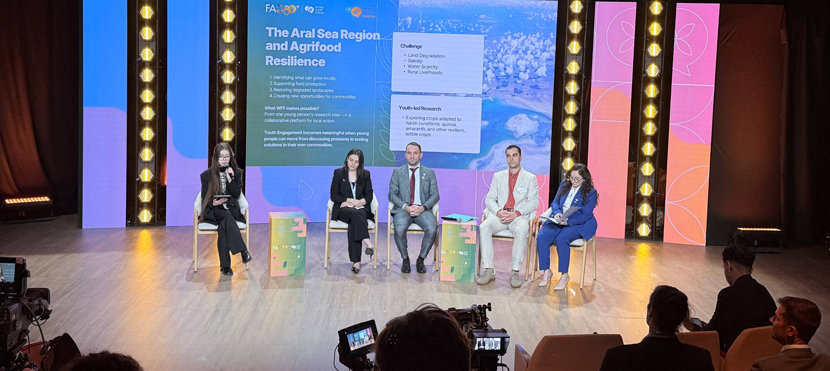
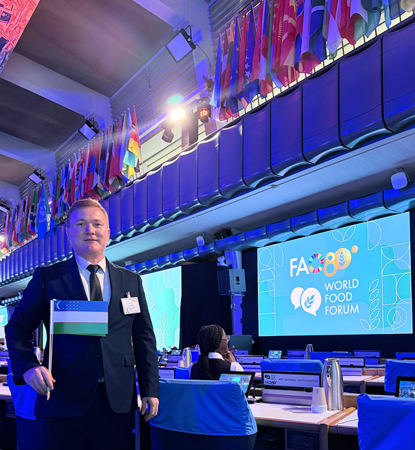
Rome, Italy, 15 October 2026 — The World Food Forum 2026 is taking place at the headquarters of the Food and Agriculture Organization of the United Nations (FAO) in Rome, Italy. The Forum brings together young people, experts and partners to advance sustainable, inclusive and climate-resilient agrifood systems.
Participants included Sherzod Umarov, Assistant FAO Representative in Uzbekistan, representatives of government institutions, young professionals and members of the WFF Uzbekistan National Youth Chapter. They contributed to international discussions on agrifood systems development, presented national experiences and initiatives, and exchanged knowledge with representatives of other countries.
During the opening ceremony of the Global Youth Forum, 35 new National Youth Chapters were officially launched, and their representatives received certificates. The event highlighted that the WFF network now brings together more than 100 National Youth Chapters worldwide. Throughout the Forum, youth leaders from different countries, including Shovkat Kholdorov, Coordinator of the WFF Uzbekistan National Youth Chapter, exchanged experiences on local initiatives addressing food security, sustainable agriculture and climate issues, and explored opportunities to expand international cooperation.
The WFF Uzbekistan National Youth Chapter was established in 2025 at the initiative of young people, in collaboration with the FAO Representation in Uzbekistan and with support from the Ministry of Agriculture and partner organizations. It is the first WFF National Youth Chapter in Central Asia.
 As part of the Forum, FAO’s Regional Offices for Europe and Central Asia and for Asia and the Pacific organized an interregional dialogue on the future of young pastoralists. Representatives of WFF National Youth Chapters from Uzbekistan, Kazakhstan, Mongolia, Nepal and Bhutan presented findings from national consultations and discussed policy recommendations, partnerships and investment opportunities to support pastoralist communities.
 Akhmadjon Nurullayev, Chief Specialist at the Social Policy Laboratory of the International Agriculture University, represented Uzbekistan in the dialogue and presented the findings of national consultations. According to the findings, 71 percent of the young pastoralists surveyed reported declining productivity, while 58 percent had experienced losses associated with livestock mortality. Limited access to water, veterinary services and markets was identified as a major barrier by nearly 70 percent of respondents. Climate variability, restrictions on seasonal livestock mobility, insecure pasture use rights, and difficulties accessing land and financial resources were also reported to undermine the stability of young pastoralists’ incomes and livelihoods.
In response to these challenges, Uzbekistan’s representative proposed developing a regional programme to support young pastoralists. The proposal covers participatory pasture management planning, strengthening pasture use rights and seasonal mobility, and improving access to water, veterinary services and financing. It also calls for national pilot initiatives to ensure the formal participation of young women and men in decision-making. Regional cooperation on drought information exchange and rangeland monitoring is envisaged to support these measures.
During the Forum, Uzbekistan’s Minister of Agriculture, Ibrohim Abdurahmonov, also met with young Uzbek professionals undertaking internships at FAO. Discussions focused on applying international knowledge and experience to agricultural practices in Uzbekistan, improving water use efficiency, adapting to climate change, introducing innovations and strengthening food security. The Minister encouraged the young professionals to study advanced solutions, adapt them to national conditions and contribute to the development of the agricultural sector.
The interregional dialogue aligns with the objectives of the International Year of Rangelands and Pastoralists 2026, proclaimed by the United Nations General Assembly. With FAO serving as the lead agency, the initiative highlights the contributions of rangelands and pastoralist communities to food security, biodiversity conservation and climate resilience. The recommendations presented by young people can help inform national and regional cooperation in these areas.