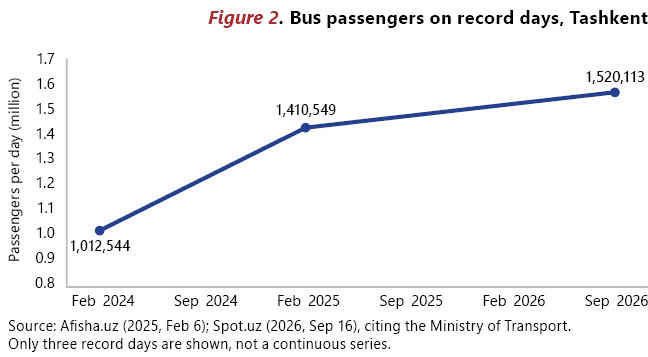
These changes should not be attributed to GCC or AFC alone. During the same period, the bus fleet expanded to 1,847 vehicles between 2022 and 2025. The available figures demonstrate improvement during the reform period, but do not isolate the effect of each measure.
An emerging problem under the new system
The reforms made revenue flows more transparent, but weakened the direct incentive for drivers and conductors to ensure that passengers paid. Under GCC, drivers are paid for operating the service, while fare compliance is primarily the responsibility of passengers and inspectors. Fare evasion is therefore an important operational challenge.
In 2025, Tashkent had only 57 fare inspectors. The paper estimates that this might amount to around 5% of bus lines, although this is not an official figure. A total of 19,500 fines were recorded in 2025. In the first seven months of 2026, the number reached 79,618. If the number of inspectors remained at 57 throughout that period, this would amount to roughly 375 fines per day across the team.
These figures show the scale of enforcement activity, not the total number of passengers who travel without paying. The increase from 19,500 fines in 2025 to 79,618 in the first seven months of 2026 may reflect stronger enforcement, increased evasion or both.
Solutions and answers to the research questions
The following proposals aim to improve fare compliance while preserving the main benefits of GCC: transparent revenue collection, predictable driver remuneration and the removal of incentives to compete for passengers.
A hybrid incentive system for drivers
The basic GCC model pays drivers according to the kilometres they complete or another predetermined service measure. A hybrid model could restore some responsibility without returning to the old cash-based arrangement.
Under the proposed 85/15 model, 85% of a driver’s regular wage would remain fixed. The remaining 15% would be paid as a monthly bonus if the fare-validation rate on the driver’s bus reached a defined threshold.
Validation Rate = (successful fare validations on the driver’s bus ÷ estimated number of passengers on board) × 100%.
If the rate remained above the agreed threshold, the driver would receive the full 15% bonus. Since the calculation would rely on official ATTO records and sensor data, drivers would have less opportunity to manipulate the figures.
The proposed model has three potential advantages. First, it does not reward drivers for carrying more passengers or overtaking other buses, so it should not recreate the competition associated with NCC. The model should nevertheless be treated as a proposal for a controlled pilot, not as a proven solution.
International examples offer indirect support. In Santiago, Chile, the bus system moved from pure GCC towards an Incentivised Gross-Cost Contract (IGCC) after renegotiations in 2012–2013. One field experiment found that a performance bonus increased the number of passengers transported by 9% on long routes, while average bus speed decreased by 3%. However, the bonus targeted service performance and passenger numbers, not fare validation, so it does not establish that an 85/15 validation bonus would reduce fare evasion.
Yerevan, Armenia, provides a different example. In April 2026, intensified inspections on public transport were followed by a reported 15–30% increase in fare-validation rates within two weeks and an additional 28 million Armenian drams in daily revenue. In September 2026, the city recorded 3.6 million validations across buses, metro and trolleybuses in a single week.
Kazakhstan, particularly Astana and Almaty, is relevant mainly as broader regional context. Public transport there relies heavily on state subsidies because the cost of carrying passengers is higher than the fare revenue collected.
Taken together, these cases provide useful but limited evidence. None tests a bonus specifically linked to fare-validation rates. The proposed 85/15 arrangement should therefore be piloted and evaluated before any citywide adoption.
Passenger-counting sensors and targeted enforcement
Human inspectors remain necessary, but their limited numbers make continuous monitoring of the entire network impossible. As of May 2026, only 57 inspectors were working across Tashkent. This approach allows more people to be checked in busy areas, but passengers may learn where inspectors are usually present and pay only when they expect to be checked.
Automatic Passenger Counters could help address this information gap. APC systems use sensors, including infrared devices, installed above bus doors to count passengers entering and leaving. Unlike inspectors, sensors can collect data continuously on every equipped bus.
Studies of automatic passenger-counting systems have reported accuracy above 95% and, in some conditions, up to 98%, particularly when passengers pass through doors individually and the entrance is not crowded. The reported accuracy figures should therefore not be assumed to apply equally to every APC device or operating condition.
The estimated evasion rate can be calculated as follows:
Estimated Evasion Rate = (1 − ATTO validations ÷ APC passenger count) × 100%.
For example, if a bus carries 48 passengers but only 24 fare validations are recorded, the estimated evasion rate is 50%. If the rate on a particular route exceeds a chosen threshold, such as 10%, the system could notify inspectors. They could then conduct checks on that route and at the relevant stops.
This calculation is an estimate, not a definitive measure. Passengers legally entitled to travel free of charge, validator malfunctions and counting errors at crowded doors can all make the estimated rate appear higher than the actual level of fare evasion. For this reason, the first months of a pilot should be used to test and calibrate the system.
Available project data and industry estimates suggest that APC installation on a modern three-door bus may cost approximately 3,000–5,500 US dollars. In more expensive cases, the cost can reach about 7,000 dollars per vehicle. Equipping the full fleet of 1,847 buses would therefore cost approximately 5.5–10 million dollars at 3,000–5,500 dollars per bus, or around 13 million dollars at 7,000 dollars per bus.
Sensors and inspectors perform different functions and should not be assessed as substitutes. Inspectors can discourage non-payment through their presence and issue fines, but 57 staff members cannot monitor the entire network at once. Sensors can measure passenger flows continuously on equipped vehicles, with reported accuracy of around 95–98% under suitable conditions and an estimated cost of 3,000–5,500 dollars per bus.
The pilot should test whether this targeted approach improves enforcement. This would help determine whether sensor-based deployment makes better use of the available workforce.
Dubai, United Arab Emirates, offers an example of APC adoption. Local authorities decided to equip 636 new buses with passenger-counting systems to compare actual passenger numbers with fare payments and identify possible non-payment. However, officials have indicated that the data can help identify routes with higher levels of fare evasion and deploy inspectors more effectively.
Passenger non-compliance: results of a preliminary field study in Tashkent
Technology and financial incentives may not be sufficient on their own. Understanding these circumstances is therefore important for designing effective measures. To explore possible reasons, a small survey was conducted in 2026 among 30 people who reported using public transport daily.
Method
The survey was conducted in five areas of Tashkent: Chilanzar, Mirzo Ulugbek, Sergeli, Yunusabad and the city centre. The findings therefore describe opinions about fare non-compliance; they do not measure the actual rate of fare evasion.
Results
Seventeen respondents (56.7%) identified overcrowded bus doors as a major reason for non-payment. They described rush-hour situations in which many passengers try to board through one or two doors, while the doors close quickly. Some may therefore not pay or may not even attempt to validate their fare.
Eight respondents (26.7%) pointed to long intervals between buses. In such situations, the pressure to get on board can take priority over fare validation.
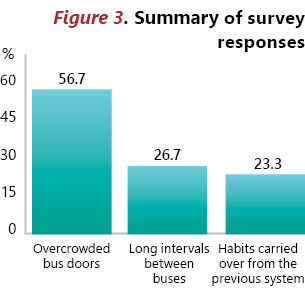
Seven respondents (23.3%) referred to habits inherited from the previous system. Some participants described this as a habit formed when the public transport system was chaotic.
Respondents could name more than one reason, so the percentages add up to more than 100% (figure 3).
4.3.3 Interpretation
The small sample means that the survey cannot confirm the causes or prevalence of fare evasion across Tashkent. Nevertheless, the responses point to several possible mechanisms. Long intervals increase the pressure to board quickly, while the limited presence of inspectors may reduce the perceived risk of being checked.
The responses about habits from the previous system also deserve attention. Seven of the 30 participants referred to a culture of non-payment associated with the earlier period of irregular service and weak control. However, the survey did not collect respondents’ ages or information about their experiences with drivers.
The survey also has limitations in relation to international comparisons. It did not use the same questions or sampling approach as studies in other cities, so its results cannot be directly compared with international data.
Practical implications
The responses suggest several low-cost measures that could complement the proposed driver incentives and APC sensors. First, the physical organisation of boarding areas and door spaces should be improved during peak hours so that passengers can reach validators more easily.
These measures do not require the same level of investment as purchasing new buses or installing sensors. They address practical barriers to payment and can be implemented alongside the measures proposed in Sections 4.1 and 4.2.
limitations
The main limitation of the field study is its small sample size (n=30) and non-random selection of participants. A larger survey should include passengers from more routes and different times of day, and should record age, travel frequency and route information.
In summary, the preliminary survey suggests that, in passengers’ perceptions, overcrowded doors, long intervals and habits inherited from the old system may contribute to non-payment.
Policy recommendations for Uzbekistan
The introduction of GCC and AFC improved the transparency of fare collection and coincided with shorter bus intervals and increased ridership. At the same time, it changed the responsibilities of drivers and conductors: they became less directly involved in fare collection, leaving more responsibility to passengers and inspectors.
Three measures should be tested on a limited scale before any citywide introduction.
First, a performance-based payment model could be piloted on 10–15 routes with the highest number of recorded fines. Under the proposed 85/15 arrangement, 85% of the driver’s payment would remain fixed, while the remaining 15% would depend on achieving a fare-validation target. The target should be based on ATTO validation records and passenger counts from APC sensors.
Second, APC sensors could be installed on 30–40% of the bus fleet, equivalent to approximately 550–750 vehicles out of 1,847. At an estimated cost of 3,000–5,500 dollars per bus, this would require an investment of around 1.7–4 million dollars. Installation should be phased, beginning with routes where the risk of fare evasion is considered high.
Third, sensor information could be used to improve the deployment of fare inspectors. Where the number of passengers counted differs significantly from the number of recorded validations, inspectors could be assigned to check the relevant routes and stops more frequently.
The three measures should be introduced as a controlled pilot, with clearly defined routes and evaluation criteria. After six months, the authorities could compare validation rates, passenger counts, inspection results and operating costs to decide whether the approach should be expanded. A phased design, with comparable routes where appropriate, would provide more useful evidence for future decisions.
Conclusion
This paper examined how Tashkent can improve fare payment without returning to the former system in which drivers competed for passengers. The introduction of ATTO and Gross-Cost Contracts made payments easier to record and changed the way drivers are remunerated.
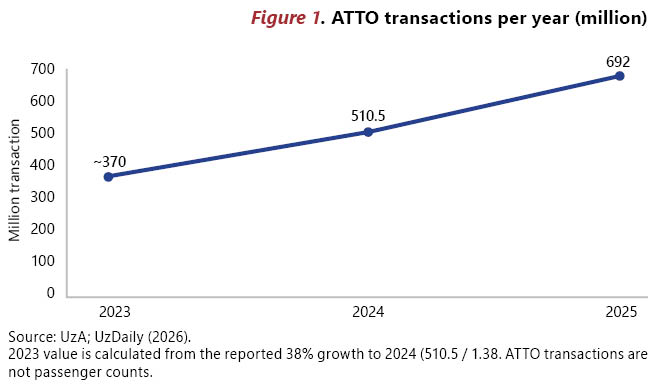
The available figures show that ATTO transactions and bus ridership increased during the reform period. In 2025, ATTO recorded 692 million transactions, while Tashkent buses carried 412.4 million passengers. However, these changes coincided with an increase in the bus fleet to 1,847 vehicles, so they cannot be attributed solely to AFC or GCC. The exact fare-evasion rate remains unknown.
The preliminary survey of 30 passengers identified overcrowded doors, long intervals and habits associated with the former system as possible reasons for non-payment. Because the sample was small and non-random, the findings cannot be generalised to all public transport users in Tashkent.
The paper therefore recommends testing three complementary measures before considering citywide implementation: a driver bonus linked to fare-validation rates, APC sensors to compare passenger numbers with recorded payments, and more targeted deployment of inspectors using sensor data. The proposed 85/15 model would retain a fixed majority of driver remuneration while making a limited bonus dependent on validation performance.
Ultimately, fare evasion is unlikely to be solved by fines or technology alone. A sustainable approach should combine reliable data, proportionate incentives, effective inspection and improvements to the passenger experience.























 16/02/2026