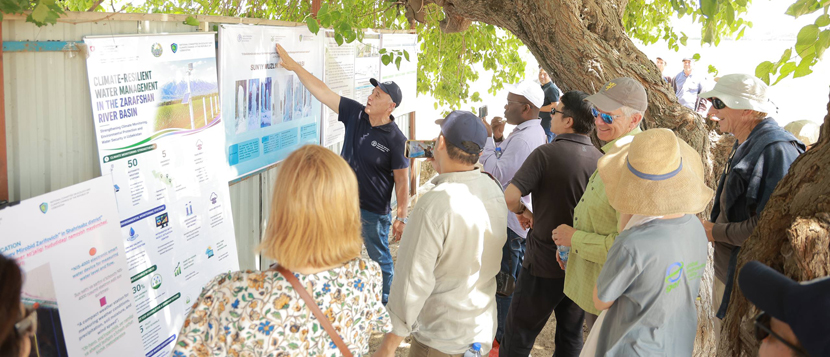
Kashkadarya, Uzbekistan — Climate-resilient agricultural technologies, water-saving approaches and sustainable forest management practices introduced under FAO projects implemented with financial support from the Global Environment Facility were presented to an international delegation in Kashkadarya Region. The delegation included representatives of the Global Environment Facility, FAO headquarters in Rome, the FAO Representation in Uzbekistan and international partner organizations.
During the visit, the delegation reviewed climate-resilient crop production technologies and sustainable forest management practices aimed at combating desertification. These approaches are being introduced under the “Food Systems, Land Use and Restoration Impact Program in Uzbekistan” (FOLUR–Uzbekistan) and the “Sustainable Management of Forests in Mountain and Valley Areas of Uzbekistan” projects.
The delegation was presented with new practices for soil conservation, efficient use of water resources and drought management in agriculture, as well as technologies and approaches aimed at restoring degraded landscapes and promoting the sustainable development of the forestry sector.
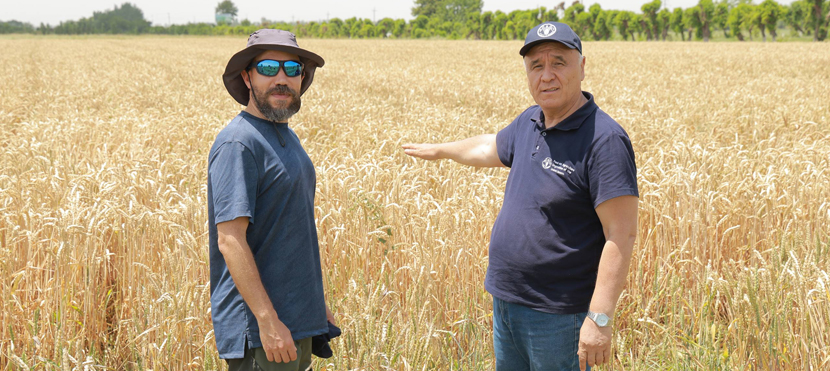
The first destination was the FOLUR–Uzbekistan demonstration site located in the Savsan mahalla citizens’ assembly area of Qamashi District. Here, the delegation was introduced to no-till winter wheat production under rainfed conditions. The technology protects soil from excessive mechanical disturbance, retains crop residues on the soil surface, reduces moisture loss and improves water infiltration, thereby supporting high yields even in dry years. This technology and approach are particularly important for rainfed areas that are increasingly affected by water scarcity, drought and climate variability.
The advantages of rainwater harvesting technologies were also demonstrated at the site, and information was provided on the condition of pistachio seedlings cultivated through the efficient use of rainwater. Depending on the slope gradient, the system includes stone-reinforced and unreinforced gradoni terraces, semicircular water-harvesting structures and water-diversion channels. These new technologies are nature-based solutions, as they improve soil moisture retention and make it possible to direct water straight to plant root zones. Their positive impact on seedling survival left a favourable impression on the participants.
The visit then continued at a demonstration site established on a farm located in the Mo‘minobod mahalla citizens’ assembly area of Shakhrisabz District. Here, the delegation was presented with no-till wheat production under irrigated conditions and a “Smart Water” cotton field based on the efficient use of water resources.
During the demonstration, participants discussed the differences between conventional agricultural practices and soil-protective, resource-efficient technologies, as well as opportunities to preserve soil fertility, improve irrigation efficiency, manage soil moisture and adapt agricultural production to water-related risks.
“The field visit enabled international partners to directly observe the practical results of the approaches promoted under the project. No-till planting, rainwater harvesting and improved irrigation methods are not isolated technologies — they are components of a single integrated approach aimed at achieving high yields even in dry years, restoring soil health, using water efficiently and introducing new technologies that enable farms to adapt to climate change,” said Aziz Nurbekov, Coordinator of the FOLUR–Uzbekistan project.
The next part of the visit took place at a training centre established in Kitob District under the “Sustainable Management of Forests in Mountain and Valley Areas of Uzbekistan” project. The centre serves to strengthen the knowledge and skills of forestry specialists and local stakeholders, conduct technical training and promote the exchange of experience in forest restoration and the rehabilitation of dryland ecosystems.
The delegation also visited a nursery and greenhouse complex in the Makrid area. The participants were shown ongoing work to produce high-quality planting material for forest restoration and landscape rehabilitation, adapt seedlings to local climatic and soil conditions, provide proper care and improve nursery management.
The facilities in Makrid demonstrated the practical areas of work under the sustainable forest management project, including forest restoration, strengthening seedling production capacity, rehabilitating degraded areas and developing the technical capacities of forestry specialists.
The field visit provided an important platform for the exchange of practical experience among the international delegation, project teams, local specialists and farmers. Participants discussed the effectiveness of the demonstrated technologies, their monitoring, adaptation to local conditions and the possibility of scaling them up across Kashkadarya and other regions of Uzbekistan.
The GEF-funded FOLUR–Uzbekistan project is implemented by the National Committee of the Republic of Uzbekistan on Ecology and Climate Change, the Ministry of Agriculture of the Republic of Uzbekistan and the Food and Agriculture Organization of the United Nations. The project aims to scale up best practices and innovations for the development of sustainable and inclusive wheat-based production landscapes and value chains.
Activities under the FOLUR–Uzbekistan and sustainable forest management projects contribute to the conservation of soil and water resources, the restoration of agricultural and forest ecosystems, the strengthening of local specialists’ capacities and the climate resilience of rural communities.
FAO, government institutions and international partners will continue their cooperation to scale up soil-protective, water-efficient and climate-adapted practices, restore degraded landscapes and promote sustainable agriculture and forestry.











 16/02/2026