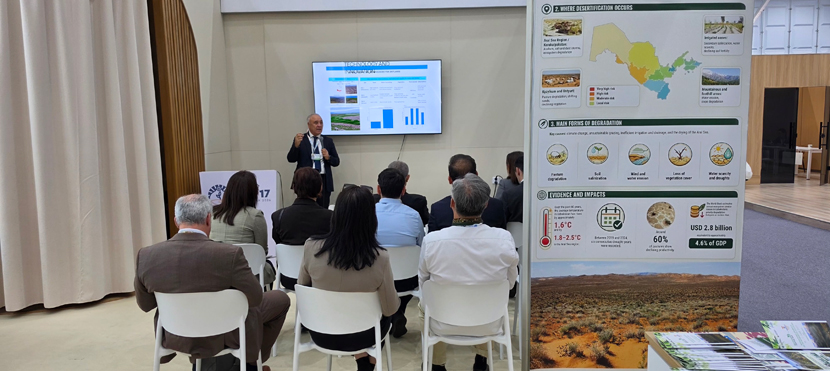
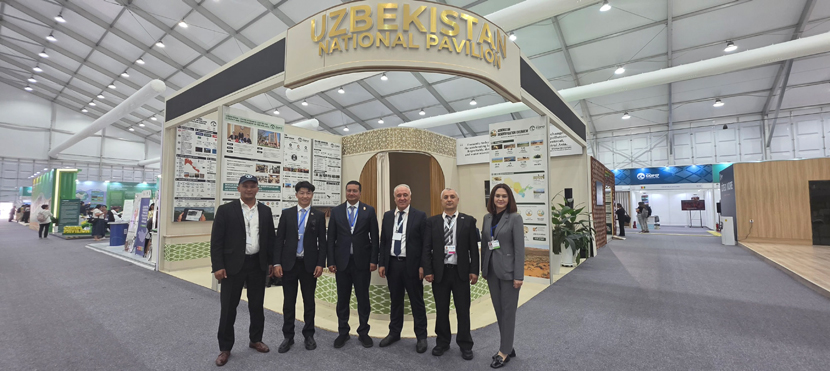
ULAANBAATAR, MONGOLIA – 27 August 2026 – The Food and Agriculture Organization of the United Nations (FAO) presented Uzbekistan’s experience in advancing sustainable agriculture, restoring soil health and promoting integrated landscape management during a side event held at the seventeenth session of the Conference of the Parties to the United Nations Convention to Combat Desertification (UNCCD COP17).
Held on the conference’s Food Systems and Soil Health Day, the event provided a platform for sharing practical solutions and lessons learned from Uzbekistan in addressing land degradation, improving the sustainable management of land and water resources, and strengthening the resilience of agricultural production systems and rural communities to climate change.
FAO experts and national and international partners presented approaches being implemented in Uzbekistan through the Food Systems, Land Use and Restoration Impact Program (FOLUR). Funded by the Global Environment Facility (GEF), the FOLUR–Uzbekistan project is implemented by FAO in cooperation with the National Committee of the Republic of Uzbekistan on Ecology and Climate Change and the Ministry of Agriculture of the Republic of Uzbekistan.
Aziz Nurbekov, FAO FOLUR–Uzbekistan Project Coordinator, presented conservation and regenerative agriculture practices being promoted in the country to restore soil health, reduce land degradation and improve the long-term sustainability of agricultural production.
Sherzod Nizamov, Team Leader of the FOLUR–Uzbekistan project and representative of the Ministry of Agriculture of the Republic of Uzbekistan, delivered a presentation entitled “Integrated Landscape Management for Sustainable Wheat Production in Uzbekistan.” He highlighted approaches that connect sustainable wheat production with landscape-level planning, the responsible management of land and water resources, and measures to strengthen the resilience of agricultural landscapes.
Alexander Iscenko of the International Union for Conservation of Nature (IUCN) presented approaches for integrating biodiversity considerations into agricultural production systems while supporting sustainable production and the conservation of natural ecosystems.
The discussions demonstrated how cooperation among government institutions, FAO, technical partners and rural communities can translate sustainable land management principles into practical action. Participants also exchanged knowledge on conservation and regenerative agriculture, biodiversity-sensitive production and integrated landscape planning in dryland regions.
FAO’s participation in UNCCD COP17 contributed to raising the international visibility of Uzbekistan’s efforts to restore degraded land and build more sustainable and resilient agrifood systems. The event also supported dialogue with governments, international organizations, research institutions and development partners on opportunities to expand proven practices and strengthen cooperation in sustainable land and natural resource management.







 16/02/2026